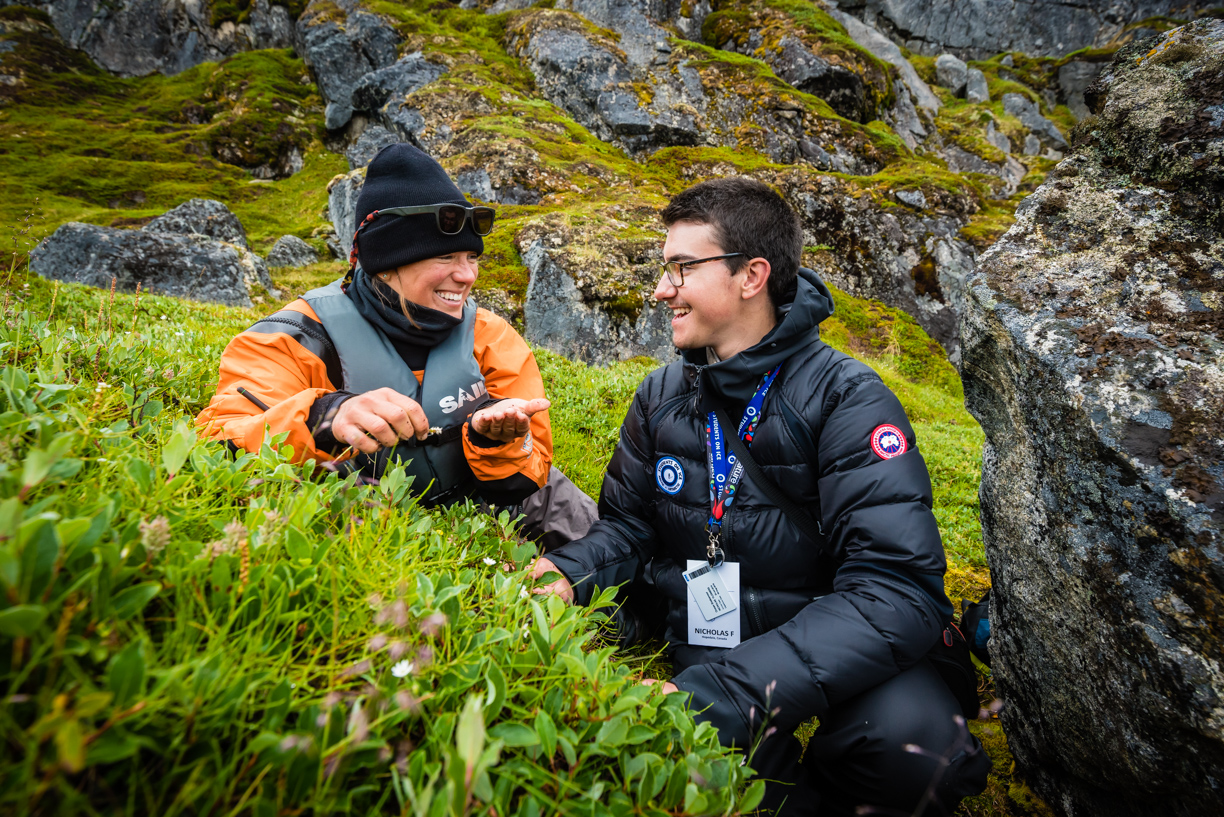
STUDENTS ON ICE is an award-winning organization offering unique educational expeditions to the Antarctic and the Arctic. Our mandate is to provide students, educators and scientists from around the world with inspiring educational opportunities at the ends of the Earth and, in doing so, help them foster a new understanding and respect for the planet.

 
| Wednesday June 19, 2013 | Contact Us  

Your donation helps make scholarships available to support the participation of students on our transformative educational expeditions. Thanks to the generous support of donors and partners, over 2000 students from more than 50 countries have participated on Students on Ice expeditions. .


TEAM

Students on Ice Expeditions has brought together an international team of scientists, historians, artists, explorers, authors, educators, leaders, innovators and polar experts, whose experience and enthusiasm ensures that our students develop a deeper understanding of and appreciation for the polar regions and the planet. Our staff team helps to make all SOI programs an unforgettable adventure!

SOI
HEAD OFFICE
The following staff work full-time with Students on Ice based out of our head office in Gatineau, Canada:
GEOFF GREEN
Founder, Executive Director
& Expedition Leader

Canadian adventurer, environmentalist and educator Geoff Green has been leading expeditions and adventures from pole to pole for the past fifteen years. Many notable organizations such as the Discovery Channel, World Wildlife Fund, National Audubon Society and the Smithsonian Institution enlist Geoff to lead their groups into the world’s most remote and exciting regions.

Geoff was recently appointed to the Order of Canada in recognition of a lifetime of distinguished service to the nation and to humanity through his work with Students on Ice. In 2010, he was recognized as one of 25 Transformational Canadian and in 2005 he received a Certificate of Special Congressional Recognition from the U.S. Congress for his work with youth and the environment. He was also voted one of Canada’s “Top 40 under 40” – an annual national prize event saluting Canada’s top young leaders. In 2004, Outpost Magazine chose Geoff as one of the “Top 5 Canadian Explorers” to watch.

Geoff is the founder and Executive Director of Students on Ice Expeditions, an award-winning educational organization based in Gatineau, Quebec, Canada. The program – now in its twelfth year – has taken over 2,000 students, teachers and scientists from around the world on expeditions to the Arctic and the Antarctic. The goal of this unique project is to give the world’s youth a heightened understanding and respect for the planet’s global ecosystem, and the inspiration to protect it.

As expedition leader, Geoff is a veteran of 80 Antarctic expeditions and 36 Arctic expeditions.

To read Geoff's full biography click here. To learn more about Geoff, visit GeoffGreen.ca.

MARK BROOKS
Manager, Communications & Media Relations

 
Mark joined Students on Ice in 2012 as the Manager of Communications and Media Relations. Prior to this, he worked for several years as a policy analyst for the Government of Canada and as a project manager for an environmental consulting firm.


With a Master’s degree in environmental and economic policy from McGill University, he is also a part-time professor in the Environmental Studies program at Algonquin College in Ottawa and a freelance environmental journalist. Mark is the current host and producer of Earthgauge Radio on CKCU FM in Ottawa, for which he has interviewed many prominent and inspiring environmental leaders (including Geoff Green!).

Mark is originally from Vancouver and he has a long history of involvement in the environmental movement. He has had the opportunity to visit numerous countries, including extended periods working in South Africa and Panama. An outdoors enthusiast, Mark has a particular passion for rock climbing, hiking, cycling and skiing. He believes strongly in the transformative and educational power of the natural world.

MARY-ELLEN CONNOLLY
Manager, Finance

 
Mary-Ellen Connolly has worked in finance since graduating from St. Lawrence College. She brings many years of financial and administrative experience to Students on Ice. SOI’s mandate and work with youth motivated her to join the team.
 
For the past 25 years Mary-Ellen has volunteered as a ski instructor/guide for CADS (Canadian Association Disabled Skiers). She also enjoys sports such as skiing, cycling, kayaking and hiking.

 
Mary-Ellen also enjoys mixing international travel with volunteer work. Her most recent service adventure in 2013 brought her back to Cambodia with Habitat for Humanity. She has finished her HFH Team Leader certification and will be planning her first build as a Leader to Chile in the near future. Some of her other memorable past travels have been to Brazil, Kenya, Vietnam and Ireland.

Contact Jessica

JESSICA FREEBORN
Manager, Projects & Partnerships

 
Jessica Freeborn started working with Students on Ice in June 2012. Her appreciation for the environment and the outdoors stems from her travels around Canada and the world, including Europe, Asia and North America. Jessica holds a Bachelor of Arts, Combined Honours degree in Anthropology and English from McMaster University and an Advanced Diploma in Applied Museum Studies from Algonquin College.

 
Jessica has worked as a Research and Collections Assistant at national and international museums, including the British Museum in London, England and the Canadian Museum of Civilization. As a Technical Writer for the Canadian Museum of Nature, she wrote a document entitled “A Collections Development Strategy for Canada’s Natural History Museums” which outlined sustainable management practices for Canada’s natural history collections. Most recently, Jessica was the Coordinator for the Alliance of Natural History Museums of Canada. Her work with youth extends to her time as an Early Education and Teaching Assistant where she supervised and taught daily educational lessons.

When not at work, Jessica can be found hiking and cave spelunking in the Ottawa region or enjoying a good book at the cottage located north of Parry Sound.

Contact Clare

CLARE GLASSCO
Manager, Expedition & Education Programs

Clare Glassco has been leading high school students on expeditions around the world since 2007. From Ecuador to Egypt, Clare has worked to provide transformative educational experiences for young adults far away from their homes and comfort zones. A graduate of Canadian Outdoor Leadership Training on Vancouver Island, Clare's belief in the need to reconnect students to the outdoors in order to sustain both the planet and future generations has led her to Students on Ice.


Clare recently completed a Master's thesis on the history of the Seasonal Agricultural Workers Program in Canada, a migrant labour scheme that has been in operation since 1966. In 2010, she received a Social Sciences and Humanities Research Council fellowship to further her work.


As the Manager of Expedition and Education programs, Clare works with a team of expert educators to create transformative educational programming for SOI participants. She also manages the day to day operations of the expeditions and provides support for expedition staff, educators, chaperones and student participants. As part of her work, Clare travels on all of SOI's Arctic and Antarctic expeditions.

LISA (DIZ) GLITHERO
Chair, Education Advisory Committee


Education, youth and the environment have been the focus of Lisa Glithero’s professional and personal life. With Bachelor of Science, Education and Master of Education degrees, she has taught in Canada, Nepal and has served as the Education Program Director for Students on Ice. Through 8 Polar Expeditions, Lisa has witnessed firsthand the impacts of climate change, further igniting her passion to connect today’s youth to the planet’s global ecosystem.

Lisa’s dedication towards a ‘greener’ society led to her establishment of the EYES Project in 2004. EYES is a Canadian not-for-profit organization committed to bringing a sustainability imperative into educational pedagogy and practice. She is currently a Visiting Professor with the Faculty of Education at the University of Ottawa and continues to serve as the Director of the EYES Project, as well as Chair of the Education Advisory Committee for Students on Ice. Lisa is also a board member of the Chelsea Foundation.

In March 2006, she was honoured with an international "Women of the Earth Award" by the Yves Rocher Foundation for her work in environmental education and in April 2008 was named by Nobel Peace Prize Nominee (2007) Sheila Watt Cloutier, as one of Chatelaine’s “Amazing Canadian Women to Watch.”

Lisa lives in Chelsea, Quebec with her partner Geoff, son Fletcher and daughter Nellie.

SHIRLEY MANH
Manager, Participants and Alumni Programs


Shirley has spent her career working with youth in a variety of contexts. Since 2005, she has travelled and worked as an Educational Tour Leader, leading innumerable trips with student groups to various cities across Canada and the United States. Training and managing teams of tour leaders over the years has also given her a passion for facilitating personal growth and professional development in young professionals.

In 2010, Shirley spent two months cycling and performing with The Otesha Project and then worked as the Development Director. Her involvement with Otesha supported creative environmental education programs that explore sustainability initiatives and social justice issues. She is passionate about living with intention, conscious consumption, and waste reduction.

Having spent her career working to provide innovative and transformational experiential learning opportunities to young people, Shirley is thrilled to work with SOI participants and alumni before, during, and after expeditions.

MAATALII ANERAQ OKALIK
Manager, Partnerships & Development
 
Maatalii Aneraq Okalik is originally from Pangnirtung, Nunavut. She is currently completing a degree in Human Rights and Political Science with a minor in Aboriginal Studies at Carleton University. An active community member within Ottawa, she is the President of the Ottawa Inuit Children’s Centre, a Committee member of Project North and a Founder of the Inuit Students Association of Carleton University. Guiding her decisions and actions by Inuit Societal Values based on Inuit Qaujimajatuqangit (traditional Inuit knowledge) Maatalii dedicates her education and experience toward healthy communities – identifying gaps and solutions for social betterment of Inuit in Ottawa and across Canada.

Prior to joining the Students on Ice team in June 2012, she has worked as a policy analyst and researcher with the Inuit Relations Secretariat, Inuit Tuttarvingat within the National Aboriginal Health Organization, and the Nunavut Court of Justice. Maatalii has worked with First Nation, Métis and Inuit youth for the past ten years and is currently coordinating a Youth and Arts project with the Michaëlle Jean Foundation.

Maatalii’s research interests include Indigenous epistemologies, culture, governance and politics, self-determination and sovereignty; the Circumpolar world; human rights and law. Her favourite things to do are to spend time with family, watch movies, and dream about the future! When she is back home in Nunavut, boating, fishing, hunting, hiking and throat singing and laughing with family and friends are what occupy her time.

REINA LAHTINEN
Advisor


Reina worked at Students on Ice from 2007-2012 as the Operations Manager, Outreach and Participant Coordinator and the Partnership and Development Manager.
 
She graduated from the University of Ottawa's Bachelor of Education program and holds a Bachelor of Arts in Law from Carleton University. Reina is passionate about community engagement, having held positions on the Board of Directors of the Canadian Nordic Society and Eco Echo - Outaouais Environmental Campus.


TIM STRAKA

Advisor
 
Tim worked at Students on Ice from 2007-2012 as the Education Director. He co-creates transformative learning experiences with students of all ages. Committed to environmental and civic education, he has taught at elementary, secondary and post-secondary levels across North America, in Central Europe, in the Arctic and Antarctica.
 
Tim has worked with Outward Bound Canada, the YMCA of Greater Vancouver, the Kawartha Pine Ridge District School Board, the Kawartha Outdoor Education Centre, Ontario's Ministry of Education and several Canadian Parliamentarians. He is a member of the Canadian Network for Environmental Education and Communication, the Ontario College of Teachers and the Council of Outdoor Educators of Ontario.
 

Tim earned a Master of Science degree in Environmental Studies from Lesley University, and undergraduate degrees in Outdoor and Experiential Education (Queen's University) and Politics (Bishop's University).

SOI EXPEDITION
EDUCATORS
The following scientists, educators, artists, leaders & innovators join us from time-to-time on our expeditions:

JOLLY ATAGOYUK
Printmaker


Jolly is dedicated to keeping his culture strong through artwork. Much of the strength of the print tradition thriving in his home community of Pangnirtung, Nunavut Territory, can be attributed to Jolly's talent, enthusiasm and generosity.

Jolly’s work in stencil, lino prints and etching is cherished by collectors around the globe. He has also become known for his woodcuts, silkscreens, watercolours, sculptures, jewellery and filmwork.

Jolly regularly tours the south, promoting the release of the Annual Collection of Pangnirtung prints. His work can also be found in 22 Northern Image Galleries across Canada.

In addition to interpreting original drawings from the community archives, Jolly creates his own imagery. Animals and spirit creatures are recurring motives in his work. He hopes that through his work people will learn more about Inuit culture, its traditions and the art of printmaking.


INGRID BAJEWSKY
Geographer & Geologist


Ingrid Bajewsky taught physical geography and geology at Nipissing University, teaching a variety of courses including general geology, natural hazards, geomorphology, and paleoclimatology and climate change.

Her research interests however, lie specifically in the area of glacial hydrology, with a particular interest in rock glaciers. She has conducted glaciological research in the Canadian Rocky Mountains and the Saint Elias Mountains in Yukon Territory. Ingrid ’s commitment to helping university students attain their goals led her to teaching a course entitled University Success. She holds Bachelor and Masters degrees in Physical Geography, and a Bachelor of Education. During her career Ingrid has also held positions as an environmental consultant and a substitute teacher.

NORMON BAKER
Explorer


Norman Baker's adventures started early. He won a contest for taking flying lessons at the age of 13 and soloed on his 17th birthday.

Thor Heyerdahl, whom Mr. Baker met in Tahiti, engaged him as celestial navigator, radioman and second-in-command on his three reed boat expeditions, Ra, Ra II, and Tigris.

In addition to working as an engineer, Norm was for nine years captain of the sailing schooner Anne Kristine, a Norwegian ship built in 1868 and one of the oldest vessels plying the open seas, conducting sail training and ocean research several months each year. He, his wife and children worked three years rebuilding Anne Kristine in the British Virgin Islands before sailing her in the Tall Ships Parade for the Statue of Liberty Centennial Celebration in New York. Most recently he participated in research expeditions to Easter Island in the South Pacific. He is a Fellow and Director of The Explorers Club, does white water canoeing, scuba diving, horseback riding, flying, served as a senior member of the National Ski Patrol and as an instructor of oceanography with the Naval Reserve in which he holds the rank of Commander.

MIKE BEEDELL
Photographer, Videographer, Conservationist
& Outdoor Educator


Mike Beedell has 35 years of experience documenting remote locations of the planet. He has been exploring Antarctica for 12 years and the Arctic for 35 years.

His passion for the Polar regions has sculpted much of his career. His landscape and conservation photography has been exhibited internationally at World Expos, Olympic Games and at the United Nations. He is the author/photographer of the Canadian bestseller The Magnetic North. Mike has logged tens of thousands of kilometers by canoe, kayak, dog team and sailboat during his career. These experiences have been published in best-selling books, magazines and radio and film documentaries.

Mike is the director of O Canada! Expeditions – a boutique travel company that immerses people in conservation awareness and unique experiences around the world. One of his greatest rewards is introducing newcomers to the rugged yet fragile parts of our planet that must be protected for future generations.

To see Mike’s photographic work and projects go to mikebeedellphoto.ca.


DAVID BROCK
Environmental Policy Advisor


A passion for politics and polar science has taken David Brock to both the most northerly and most southerly permanently inhabited communities on Earth. David lives in Yellowknife where he currently works as the Chief Electoral Officer for the Government of the Northwest Territories. He previously worked in the Executive Council offices of the Government of the Northwest Territories and the Government of Nunavut. David studied political science at Dalhousie University, the University of Saskatchewan and the University of Western Ontario. His past research includes the study of election law enforcement and how scientific knowledge about climate change affects government decision making in the Canadian north. In 2005, he was named a Fellow of Action Canada, a national program in leadership and public policy. He has served on the Board of Directors of the Canadian Political Science Association. His political commentary has appeared in the Toronto Star, The Walrus, and Muskoka Today.

MICHAEL BYERS, PhD
Human Rights Advocate & Environmental Activist


Michael Byers holds the Canada Research Chair in Global Politics and International Law at the University of British Columbia.

Prior to 2005, he was Professor of Law and Director of Canadian Studies at Duke University; from 1996-1999 he was a Fellow of Jesus College, Oxford University.

Michael is a regular contributor to the Globe and Mail, Toronto Star and Ottawa Citizen, and a frequent guest on the CBC, CTV and Global.

His most recent book is Who Owns the Arctic?, described by Thomas Berger as "A much-needed road map for policy-makers and an unusually readable guide for every concerned citizen who wants to understand Canada's choices in the Arctic."

Michael lives on Salt Spring Island with his wife and two young children. He enjoys running, swimming, back-country camping, music and the arts.

OLLE CARLSSON
Polar Naturalist & Lecturer


Olle was born in Sweden and is currently living there. Formerly a teacher, he left the profession in order to write, photograph, play jazz and travel. He has travelled extensively in the Atlantic sector of the Arctic, including the Northwest Passage, Greenland and Svalbard.

Since 1991, he has spent the northern winter seasons in his favorite area, Antarctica, sharing the migration route of the Arctic Tern, always heading for summer, in the North as in the South. In Antarctica he has been an expedition leader, naturalist and lecturer for various organizations. Olle admits to being infected by the Polar bug, defined by the early explorers as “if you have ventured into the ice once, you will always long to come back.” Apart from the remote North and South, he has worked as a naturalist guide, lecturer and Zodiac driver along the coasts of Europe, around England and in the Baltic Sea. He has backpacked parts of Asia and participated in a tree planting project in Kenya.

Together with his friend Stefan Lundgren, Olle has published Antarctica - In the interest of all mankind (1990), currently only in Swedish and appointed the Panda Book of 1991 by the Swedish section of World Wildlife Fund. More recently, Olle and Stefan have completed Svalbard - The Land beyond the Northcape (in English). In 1998-99, they completed another book in English, Antarctica - A souvenir book from the 7th continent. He has written several articles for magazines and newspapers, and also lectured and given slide-show presentations on the Polar areas around Sweden, Denmark and in the US.

ZOË CARON
Climate Policy & Advocacy Specialist

Zoë Caron is the Climate Policy and Advocacy Specialist for WWF-Canada. Her mandate is to work with partners to identify, build public support for, and secure Canadian government leadership on climate policy.

Beyond WWF, Zoë is the co-author of Global Warming for Dummies, Editor of International Policy on ItsGettingHotInHere.org, and is the President of the Board of Directors for Sierra Club Canada.

Prior to WWF-Canada, Zoë worked as a research associate with the Eco-Efficiency Centre at Dalhousie University coordinating the provincial renewable energy stakeholder consultation project in Nova Scotia. She has also worked with non-profit companies and organizations on sustainability, education and social mobilization. In 2008, Zoë served as Students on Ice's Alumni Coordinator.

Zoë's academic background is in international development and environmental science. She has attended multiple United Nations Climate Change Conferences, co-founded the Canadian Youth Climate Coalition, and was aboard the Students on Ice-International Polar Year Antarctic Youth Expedition 2007 (including travelling most of the way to Argentina by bus and train).

JEAN-FRANÇOIS CARREY
Guide

Ever since Jean-François Carrey was a young boy he wanted to climb Mount Everest. On May 18, 2006, not only did he fulfill his dreams, he also became the youngest Canadian to have climbed to the top of the world. JF’s passion for the Polar Regions, mountains and rivers extends back to his youth when he was a member of Scouts Canada. As a Scout, he developed some of the skills necessary to achieve his dream. These skills proved useful when, at the age of 17, JF was a apprentice guide for a wilderness adventure company, and guided one of Canada’s most extraordinary rivers, the Nahanni in the Northwest Territories.

His job as a guide enabled him to acquire many unique experiences. He led a number of expeditions down the Mountain and Snake river in the Northwest Territories/Yukon, and also journeyed to Ellesmere Island and Baffin Island in Nunavut to trek and sea kayak.

JF guides leaders and youth to think like a adventurer. He inspires people from all over the world to embrace change. He speaks internationally on leadership and unveiling the perspective gained by leading expeditions in these immense and uncontrollable environments.

KATHY CONLAN, PhD
Marine Biologist & Author


When Kathy Conlan goes to work, she suits up and dives right in - into ice-capped waters so cold that unprotected skin can freeze in seconds! The Canadian Museum of Nature marine biologist has been doing this for more then ten years in her efforts to study marine life and the impact of disturbance on the coastal seabeds of the harsh polar oceans.

Kathy first plunged into Arctic waters more than ten years ago off the coast of Resolute in Nunavut. “Research in the Arctic and Antarctic is tremendously stimulating. It is physically demanding, yet inspiring at the same time,” says Kathy. Conlan recently returned from a visit to McMurdo Station in Antarctica, as part of a new three-year study in collaboration with the U.S. National Science Foundation. Over time, this research may help scientists understand how to manage the ecological impacts of pollution in polar environments.

In addition to her research work at The Canadian Museum of Nature, Kathy is also an author. Her most recent publication Under the Ice won a Canadian Science Writer’s Association Award and was short-listed for the prestigious Norma Fleck Award for Canadian Children’s Non-Fiction.
JOHN CRUMP
Polar Issues Coordinator

John Crump works for GRID-Arendal, a Norwegian foundation that supports the work of the United Nations Environment Programme. He focuses on climate change in the Arctic and Small Island Developing States and works in a number of international settings, including the United Nations Framework Convention on Climate Change. Other projects involve Indigenous Peoples and the co-management of resources, new environmental governance structures, and other related issues. John's academic background is in journalism, communications, history and political economy. He has a Bachelor of Journalism and a Master's Degree in Canadian Studies from Carleton University in Ottawa, Canada. His love of northern regions began when he set up a tent one summer on the bank of the Yukon River. After finishing his undergraduate programme, he traveled and then wound up back in the Yukon where he worked as a journalist and met his wife. Two of his three daughters were born in the Yukon.

John has taught graduate and undergraduate courses in journalism, public administration and geography at Yukon College in Whitehorse, Carleton University and the University of Trier in the beautiful Mosel Valley in Germany.

TONY DEKKER
Musician

Tony Dekker is a singer-songwriter from the Niagara Region of Ontario who is currently based in Toronto. He is best known as the leader of his Juno-nominated folk group “Great Lake Swimmers,” which thematically focuses on a connection to the landscape and finding spirituality in the natural world, and has recorded four albums to date. Along with extensive travels that include concerts in Europe, North America, Australia, and China, he has recently been part of the National Parks Project, where 52 musicians and filmmakers participated in creating music and film for the National Parks of Canada’s 13 provinces and territories; he was part of the group that explored Cape Breton’s Highlands National Park. In addition, he has been active with the Lake Ontario Waterkeeper, part of the larger Waterkeeper Alliance, recording songs for their “Swim Drink Fish Music” digital music club. He has also teamed up with the Calgary Folk Music Festival and Winnipeg Folk Festival for youth mentorship programs in songwriting. The New York Times has described his music as “a wonderful atmosphere…minimalist well done” while Mojo (UK) has referred to it as “ambient Zen Americana.”
GARRY DONALDSON
Migratory Birds Conservation Biologist

Garry lives near the Gatineau River in Chelsea, Quebec, and works for the Canadian Wildlife Service, where he manages the national and international migratory birds program and the process for listing species at risk.

After a brief career in biotechnology, Garry began his life with wildlife when he came across an opportunity to travel to the Arctic for a month to assist on a project at the remote Coats Island seabird colony. That summer inspired many years of study, eventually earning him a Master’s degree studying the population dynamics of the Thick-billed Murre (the Arctic’s penguin), and subsequent work in the north with the Canadian Wildlife Service.

Because migratory birds go, literally, everywhere, much of Garry’s work time is currently devoted to figuring out how to achieve conservation for species that roam across Canada then fly throughout the Americas or across the Atlantic or Pacific oceans.
DAVID FLETCHER
Base Commander & Polar Historian


David has spent the last 38 years in the polar regions, including 4 winters and 35 summers. He spent fifteen years with the British Antarctic Survey (B.A.S.) as a dog driver, Base Commander and Field Operations Manager.

David is a Fellow of the Royal Geographic Society and was awarded the prestigious Polar Medal. He has also received the Fuchs medal from the British Antarctic Survey. David has participated on several Students on Ice expeditions as a polar educator.

ERIC GALBRAITH, PhD
Oceanographer & Earth Science Researcher


A native of Halifax, Nova Scotia, Eric worked as a geologist in South America and the Canadian Arctic before becoming an oceanographer.

His research looks at how global ocean circulation interacts with the rest of the climate system, what this means for marine life, and how the ocean will respond to future climate change. He is particularly interested in how the Southern Ocean controls atmospheric carbon dioxide, and what its role was during natural climate changes that occurred during the recent ice ages. He is currently an Assistant Professor at McGill University.

LYNN GILLESPIE, PhD
Botanist


Lynn Gillespie works at the Canadian Museum of Nature as a botanist and is also an Adjunct Research Professor in Biology at the University of Ottawa. She received a BSc from Carleton University and a PhD from the University of California.

Her current research is on the diversity and classification of flowering plants, particularly arctic plants, grasses and the spurge plant family. Her work uses molecular approaches to study plant evolution.

Lynn has led numerous field expeditions throughout the Canadian Arctic and South America, and has participated in expeditions to Southeast Asia and Madagascar. She has contributed to plant guides and floras of these areas, and has described numerous plant species new to science.
DAVID R. GRAY, PhD
Arctic Biologist & Historian


An arctic biologist and historian, David Gray has studied birds and mammals in Canada’s High Arctic since 1968. Formerly a research scientist with the Canadian Museum of Nature (CMN), he has made over 30 research trips to the arctic islands, studying the behaviour of musk oxen, arctic hare, and red-throated loons. As an independent researcher since 1994, he has prepared reports on Peary caribou, arctic wolves, the cultural and natural resources of three northern national parks, and the historic places of Nunavut.


He has written two books on arctic subjects (The Muskoxen of Polar Bear Pass and Alert: Beyond the Inuit Lands) and completed two Virtual Museum of Canada exhibits: The Canadian Arctic Expedition of 1913-1918 and Ukaliq, the Arctic Hare. David worked on a number of arctic films and museum exhibits for CMN, and is a Research Associate at both CMC and CMN. David has travelled to several arctic communities to interview Elders in relation to his research on arctic wildlife and history. He is at present working on two films and a book on Arctic history.
PAUL HAMILTON
Phycologist


Paul B. Hamilton has worked at the Universities of Guelph and Waterloo on the impacts of pesticides and acid rain on aquatic environments respectively, before moving to the Canadian Museum of Nature in 1984. At the museum Paul has conducted taxonomic and ecological studies across Canada, the United States, Mexico and Indonesia. Paul is the present curator of CANA (the National Phycology Collection of Canada) which holds more than 81,000 samples.

Over the years Paul was given the opportunity and privilege to explore and study freshwater aquatic systems across the Arctic Archipelago. The biology of these freshwaters is as diverse as the geology of the islands. The hidden historical records in the sediments at the bottom of these lakes and ponds are a treasure chest of knowledge that continues to capture his interest and research endeavors. Other select research projects include; water quality and microscopic life in lakes and ponds from Florida to Ellesmere Island, North America; the impact of organic contaminants and mercury on aquatic systems in northern Canada.

Paul has personal interests in history, natural history, and a special love of solo canoeing and kayaking. Through his scientific journal he has authored or coauthored the description of 27 new taxa and two new genera to science, coauthored 3 books on diatom taxonomy and ecology, and published 83 reviewed scientific papers, and 37 technical reports and popular articles.

PETER HARRISON, PhD
Geographer


Peter is a Geographer by profession and received degrees from the London School of Economics (B.A. Hons.), the University of Victoria (M.A.) and the University of Washington (Ph.D.). His areas of interest are ocean and coastal management, with particularly reference to the Arctic.

Peter started his career as a Faculty member in the Department of Geography at the University of Ottawa. In 1981 he joined the Public Service of Canada and has held senior positions in Departments such as Finance, the Privy Council Office and Indian and Northern Affairs. Peter has served as the Deputy Minister of Natural Resources Canada, the Department of Fisheries and Oceans, and Indian Residential Schools Resolution Canada.

Peter is Professor, Stauffer-Dunning Chair and Director of the School of Policy Studies at Queen’s University. He is a Fellow, Governor and Vice-President of the Royal Canadian Geographical Society and a Fellow of the Royal Geographical Society.

THE HONOURABLE
ANN MEEKITJUK HANSON

Inuit Elder & Former Commissioner of Nunavut


The 3rd Commissioner of Nunavut, Ann Meekitjuk Hanson, was appointed on April 21, 2005.

Born on the island of Qakutut, outside Kimmirut, Nunavut, she spent the first 11 years of her life speaking only Inuktitut and living in Qakutut and Kimmirut. She attended schools in Iqaluit, Qamanituaq and Toronto. She studied community development at St. Xavier University and received a diploma with honours in journalism from Nunavut Arctic College.

In addition to her work in journalism, Mrs. Hanson also served with the Government of the Northwest Territories as a community development worker, counsellor and Deputy Commissioner.

Mrs. Hanson has spent considerable time as a volunteer, helping to start a number of organizations in Iqaluit. These organizations include the Juvenile Court Committee, the Elders Group, the Inuit Cultural Group and the Quinuajuaq Society.

Mrs. Hanson lives in Iqaluit with her husband, Robert Hanson. They have five grown daughters.
SONJA HEINRICH, PhD
Biologist


Sonja Heinrich teaches marine biology at the University of St Andrews in Scotland (UK) where she also runs the Master in Marine Mammal Science programme. She is based at the renown Sea Mammal Research Unit which reflects her research interests in the furry and blubbery ocean predators. Sonja gained her PhD from St Andrews in 2006 for her work on sympatric ecology and conservation of coastal dolphins in southern Chile, holds a Masters in Marine Science degree from the University of Otago in New Zealand, and a general biology degree from the University of Cologne in Germany. Her research activities and work as guide/lecturer aboard expedition-style cruise ships have taken her all around the globe, with a notable preference for remote cool-temperate and polar regions. A keen explorer of ocean and mountain realms alike, Sonja tends to mimic the migration of the Arctic tern, with northern summers spent in Scotland and the Arctic, and northern winters at least partially in the southern hemisphere (teaching timetable permitting). Sonja has been visiting the Antarctic and subantarctic islands annually since 1998, and loves to share her passion for polar regions with students and general public alike. What better classroom setting could there be than amongst the ice and wildlife of Antarctica?
DOMINIQUE HENRI
Human Geographer & Writer


Originally from Montreal, Dominique currently dedicates her energy to research, teaching and writing. After completing a B.A. in Anthropology and French Literature, as well as an M.A. in Creative Writing specialized in Environmental Journalism at McGill University, she moved to England to pursue a D.Phil. in Human Geography at Oxford. Over the past three years, her research in the Arctic region has led her to work in collaboration with wildlife biologists, elders, hunters, teachers, students and government representatives to document and discuss Inuit ecological knowledge, as well as explore its role in contemporary environmental governance in Nunavut. The goal of her doctoral work is to support northerners and Nunavummiut in developing policies and practices that meaningfully engage both Inuit and scientific traditions and perspectives in the governance of wildlife and natural resources. Dominique teaches a master’s course in biodiversity conservation and resource management at the Centre for the Environment, Oxford. She is also a dedicated journalist and fiction writer, using writing as a tool to reflect about our relationship with the natural world. An avid cross-country skier, cyclist and canoeist, she has participated in expeditions that took her paddling across Canada and skiing across the frozen tundra. Dominique is a D.Phil. Candidate in Geography & the Environment, Linacre College, University of Oxford.
SANTIAGO IMBERTI
Ornithologist


An ornithologist, photographer and writer, Santiago was born and raised in southern Patagonia, Argentina. He obtained a degree in tourism and later in ornithology, which allowed him to combine his love for nature and the outdoors with his work as a bird watcher, naturalist, fly fisherman and mountain guide. During the Antarctic off-season Santiago does ornithology research on birds of southern Patagonia and the Antarctic. Among others, he is studying the biology of the rediscovered Austral Rail, the Magellanic or ‘Magic’ Plover and also coordinates a project to save the Endangered Patagonian endemic Hooded Grebe. He does volunteer work for the NGO ‘Ambiente Sur’ that seeks to protect the environment and educate younger generations about a sustainable living in southern Patagonia.

His articles and stories have been published in scientific journals and popular travel magazines. In recent years, two of his books on birds have been published, he has become a certified wilderness first aid responder and, since his singing abilities are rather poor, he has produced a CD of bird sounds of Patagonia and Antarctica.

Whenever he is off work, guess what? ...He goes birdwatching and sound recording, his main passions, mainly in his backyard (the rather large Los Glaciares National Park, where he lives).

JOHNNY ISSALUK
Traditional Inuit Athlete


Johnny Issaluk is originally from a small Arctic hamlet on the coast of Hudson’s Bay in Nunavut called Igluligaarjuk (known as Chesterfield Inlet). He presently resides in Iqaluit, Nunavut with his young family. Johnny has been successfully competing in Arctic sports since the age of 16. He has won countless medals over the last decade at both the regional and the national level. When Johnny is not engaged in Arctic sports at home and abroad, he also enjoys volunteering his time coaching and training the younger generation at the local gym. In addition to his love of Arctic sports, Johnny is a devoted father and a skilled hunter with a love of the land and his traditional roots.
PETER JOHNSON, PhD
Physical Geographer


Peter Johnson is a Professor of Physical Geography at the University of Ottawa where he has specialised in Arctic regions for 35 years. His research has focused on glaciated mountain regions, primarily the southwest Yukon, working on glacial geomorphology, glacier and mountain hydrology, and environmental change. He has promoted the importance of the field experience in geographical and environmental research through field courses in the Kluane Region of Yukon for over 30 years. Outside the university world he has worked extensively in the promotion of northern research emphasizing the need for research in the north, for the north and by northerners. Working with an association of universities with research in the north for most of his career, serving four years as president, and with the Canadian Polar Commission as Vice-Chair and Chair the promotion of polar research both nationally and internationally has been a priority. In the circum-arctic world he has represented Canada on the International Arctic Science Committee, the University of the Arctic Council, and the Northern Research Forum. His current focus is on the participation of Canada in the International Polar Year 2007-2008 emphasizing the "human dimension" of polar research.
ELIN KELSEY, PhD
Educator & Writer


Elin Kelsey is passionate about facilitating people’s experiences and stories about the environment through writing, science and other creative means. She is the acclaimed author of natural history and environmental books for adults and children, including Watching Giants: The Secret Lives of Whales and Not Your Typical Book About the Environment - a hopeful book about the environment for kids. Deeply committed to the marine environment, she works with a coalition of 40 aquariums engaged in communicating climate change and the oceans. She wrote the scientific brief that resulted in the establishment of the world’s largest marine reserve in 2009.

Elin has led tours to the Canadian Arctic, India, Nepal, Kenya, Botswana, Zimbabwe, Indonesia, Malaysia, and Micronesia and is eager to gather collective impressions of Antarctica through people on this expedition in ways that shift environmental messages beyond “doom and gloom” towards hope and resilience. She has directed exhibit and education programs at the Calgary Zoo, Vancouver Aquarium, and the Canadian Museum of Nature and now consults with international environmental organizations such as the World Conservation Union, Pew Ocean Legacy and Conservation International. Elin is an adjunct professor at Royal Roads University in Victoria, BC and a Visiting Scholar at James Cook University in Australia. She spends most of her time trying to live a “one planet” life – and get the laundry folded – at her home in Pacific Grove, California. You can see more about Elin at www.elinkelseyandcompany.com.

WILLIAM LISHMAN, PhD (Hon)
Artist, Inventor, Filmmaker & Naturalist


William Lishman is a versatile artist of world renown. His works over the past three decades include two award winning films and numerous works of public art, which include an 86-foot high central theme Sculpture for Expo ‘86 in Vancouver and a 2700 square foot 21st century earth integrated dome home. He and seven pieces of his sculpture star in the acclaimed 3D IMAX film The Last Buffalo.

He was one of the pioneers of ultralight flight in Canada and in 1988 became the first human to lead birds in formation. In 1993 he led the first experimental ‘migration’ of geese from Ontario to Virginia, which was documented by ABC’s 20/20.

Bill’s autobiography was published and released by Crown Publishers and made number four on the bestseller list in Canada. Loosely based on Bill’s life, Columbia Pictures produced the hit feature film Fly Away Home released in the fall of 1996.

Bill has received numerous awards including the Odyssey of the Mind’s prestigious Creativity Award, which he shares, with the likes of Walt Disney, Chuck Jones and NASA as well as Canadian Pilots and Owners Association’s highest award in general aviation. In September of 2000 Canadian Governor General Adrienne Clarkson bestowed the Meritorious Service Medal on Bill for his work with birds and bringing Honour to Canada. Bill received an honorary Doctor of Laws degrees from the University of Ontario Institute of Technology in June 2008.

Over the past decade, while continuing his work as a Sculptor, Bill has presided over the ‘Operation Migration’ organization he co-founded to carry out research in ultralight led bird Migration. The Operation Migration team is currently working with the U.S. Fish and Wild Life Service and several other organizations to restore a flock of Migratory Whooping Cranes to eastern North America.
LINDA MACKEY
Landscape Artist

Linda Mackey, Canadian landscape artist, is Students on Ice’s Art Director, Art Liaison for the International Polar Year International (IPY) Programme Office, Director of Arctic Quest and founder of Polar Artists Group. She first traveled to the High Arctic in 2002 with renowned artist Doris McCarthy and returned with a passion to share the Arctic with others. She led a group of artists to Pangnirtung, Baffin Island for a sketching trip in 2004, and with Kathy Haycock of Eganville, Ontario, and Bonnie Levinthal of Philadelphia, began plans for Arctic Quest and celebrating the 100th anniversary of the Northwest Passage in 2006. The Arctic Quest project is fully endorsed by IPY, project #338.

Linda’s painting Follow Your Dreams was presented to Ontario’s Lieutenant Governor the Honourable James Bartleman in 2006 by the TCDSB as part of their twinning initiative between Nunavut and schools in Toronto. Linda has taught thousands of school children and artists art workshops based on her Arctic travels and is Artist in Residence for the TCDSB and The Club at Bond Head. She has also been Artist in Residence and presented powerpoint presentations and workshops on the Arctic for galleries, museums, and art groups including McMichael Canadian Art Collection and Varley Art Gallery. Linda is a former board member of the Society of Canadian Artists and an elected Signature Member of the Worldwide Nature Artists Group.

The Arctic inspired Linda to simplify light and form in her paintings and she is best known for her Arctic landscapes. She has won several awards for her work, which can be found in collections across Canada, United States, and England.

PETER MANSBRIDGE
Journalist


Peter Mansbridge is the chief correspondent of Canadian Broadcasting Corporation's news service. He anchors CBC's flagship nightly news program, The National, and all CBC News specials. He is also host of CBC News Network's Mansbridge: One on One.

Mansbridge began his career in 1968 in Churchill, Manitoba where he helped develop CBC Radio's news service to northern Canada. In 1971, he moved to Winnipeg as a reporter for CBC Radio, and in 1972, joined CBC Television. He became The National's reporter in Saskatchewan in 1975, and, in 1976, was named one of the program's parliamentary correspondents in Ottawa. He became chief correspondent and anchor of The National in 1988.

In more than 40 years with CBC News, Mansbridge has provided comprehensive coverage of the most significant stories in Canada and around the world. Most recently, Mansbridge interviewed U.S. President Barack Obama-an exclusive, and Obama's first Canadian interview as President.

During a decorated career, Mansbridge has received 12 Gemini Awards for excellence in broadcast journalism. He has also received eight honorary degrees from universities across the country and has been recognized by leading universities in the United States and the United Kingdom. In 2008 Mansbridge was made an officer of the Order of Canada by Governor General, Michaëlle Jean. In 2009, he was named Chancellor of Mount Allison University in New Brunswick.

ERIC MATTSON, PhD
Geologist & Glaciologist


Eric Mattson has been conducting glaciological research for the past 20 years. Most of his research has been conducted on glaciers in the Canadian Rocky Mountains, the Saint Elias Mountains in Yukon Territory, and the Himalayan Mountain Range. Dr. Mattson’s main research interest revolves around energy balance studies (small scale and large scale), and research into variations in glacier volume to determine past, present and future trends in glacier size and melt water production. Other research involvements include snowmelt modeling in North-eastern Ontario, debris flow activity in Banff National Park, and island biogeography in Massasauga Provincial Park.

MATTY MCNAIR
Polar Explorer & Educator


I
nternationally recognized as the top woman polar guide in the world, Matty has journeyed to both Poles setting several very impressive world records. She led the first women’s expedition to the North Pole in 1997.

After leading 2 expeditions 600 nautical miles to the South Pole, Matty returned to take her daughter, Sarah, and son Eric to the South Pole. Sarah (age 18) and Eric (age 20) became the youngest in the world to ski to the South Pole. Matty and Sarah are the first Canadian women to ski all the way to the South Pole. Matty and her son, Eric (who both have duel citizenship) were the first Americans to ski all the way to the South Pole unsupported and un-resupplied. From the South Pole they kite-skied back in a world record of 17 days!

Matty has an infectious zest for life, a creative mind, a lateral problem solving approach to challenges and a great sense of humour.

ALANNA MITCHELL
Journalist & Author


Alanna Mitchell is an author and journalist who writes about science. She was a reporter for 14 years at Canada's National Newspaper The Globe and Mail and was a reporter at The Financial Post for three years before that. Now, she is independent and mainly makes her living writing popular science books and giving public talks. Her latest book, Sea Sick: The Global Ocean in Crisis, is an international bestseller and won the 2010 Grantham Prize for excellence in environmental journalism. She lives in Toronto with her husband and two children.
LEE NARRAWAY
Adventure Photographer


Lee Narraway spent her childhood exploring the wetlands, forests and lakes of Eastern Canada with her father, an outstanding naturalist and environmentalist. This ignited a passion and curiosity for the outdoors that continues to this day.

Lee received her first camera at ten years of age and soon discovered the joy of sharing her view of the world with others. She uses natural light and her ability to communicate with people to create unique environmental portraits. Her professional career is now focused on travel and adventure photography.

In her quest for outstanding images, Lee has skied, hiked, canoed, backpacked, and traveled by dog team, horseback, snow machine, helicopter, hot air balloon and icebreaker to remote and isolated parts of the world.

When she visited Canada's High Arctic, Lee became fascinated with its diversity and haunting beauty. Now, she strives to capture its mystery and magic on film by documenting the dramatic scenery, the wildlife and the evolving lifestyle and culture of the Inuit.

PASCALE OTIS
Biologist

Pascale Otis first started working in the polar regions in 2000 when she was a student at Laval University studying cold adaptations in Greater Snow Geese (that's when she was nicknamed Mother Goose!). After graduating with a Masters in Biology, she continued her research on polar species at McMurdo station in Antarctica before coming back to Canada to study the physiological response of humans exposed to extreme environments. Pascale has always loved traveling and discovering new places. Her passion for adventure led her to spend 15 months on a sailboat that wintered on the Antarctic Peninsula (Antarctic Mission, Sedna IV). Upon returning from the Ice, she then crossed the South Pacific Ocean on a smaller sailboat where she filmed and documented the impacts of environmental changes on many tropical islands. Her goal as a biologist is to share knowledge by making science accessible to the general public.

STEVEN PRICE
Conservationist & Zoologist


Steven Price is Senior Conservation Director for WWF-Canada.  He holds degrees in zoology and botany from the University of Toronto, and has worked with WWF for close to 3 decades.

Currently, Steven’s leads a team of conservation experts, addressing forest, marine, freshwater and endangered species issues in Canada.  He helped establish the Forest Stewardship Council, whose FSC label is now a marketplace sign of wood and paper products that come from well-managed forests.  Now he is helping the Marine Stewardship Council to develop a similar certification program, so that the MSC label will be a guide in Canada to seafood that comes from well-managed fisheries.

Steven lives in Toronto, enjoying cottage life and canoeing on weekends, as well as birding and other natural history adventures, whenever possible.  He prefers to sit facing the window during meetings and workshops, in case a rare falcon dashes by!

SCOBIE PYE
Polar Scientist & Historian


Scobie Pye is a research scientist with a Masters of Science degree from the University of Tasmania, Australia. Over the past 30 years much of his life has been spent in southern latitudes working with the British Antarctic Survey, and the Australian Antarctic Division and the University of Tasmania. He has spent four winters and seven summers on the island of South Georgia, two summers on the floating ice shelf station of Halley Bay in the Weddell Sea and two winters and nine summers on Australia’s Macquarie Island.

Scobie’s main scientific interests are focused on the conservation and management of Polar Regions. He has worked and traveled extensively in the northern latitudes. In 1978, Scobie was awarded the Fuchs Medal for outstanding service to the British Antarctic Survey.

JAMES RAFFAN, PhD
Geographer, Author & Polar Historian


Over the years, Jim has written for media outlets including Canadian Geographic, National Geographic, Explore, The Globe and Mail, as well as for CBC Radio and The Discovery Channel. He is the best-selling author and editor of 14 books including Summer North of Sixty, Fire in the Bones, Bark, Skin & Cedar, Deep Waters and, most recently, Emperor of the North: Sir George Simpson and the Remarkable Story of the Hudson’s Bay Company. He is Past Chair of the Arctic Institute of North America as well as a Fellow and Past Governor of the Royal Canadian Geographical Society, service for which he was awarded the Queen’s Golden Jubilee Medal in 2002.

Between expeditions and northern projects, Jim has had a number of real jobs. For 19 years, he was a professor of Outdoor & Experiential Education at Queen’s University Faculty of Education, where his teaching was recognized with a number of provincial and national awards. Since leaving Queen’s in 1999, he has been based at his home in the Rideau Lakes north of Kingston, Ontario, balancing dog walking and canoeing on Cranberry Lake with practise as a freelance writer and broadcaster with part-time work as the first Curator of the Canadian Canoe Museum in Peterborough, Ontario.
GRANT REDVERS
Environmental Scientist & Sailor

Prior to taking to a life at sea in the high latitudes, Grant Redvers worked as a scientist in New Zealand and at Scott Base in Antarctica. He has a masters degree in environmental science, and is a qualified yacht skipper and dive master.

In the early 2000s he sailed from New Zealand to Antarctica and South Georgia Island on a 45ft yacht for mixed climbing and glaciology research expeditions. After sailing back to NZ through the Pacific Islands he then joined Tara Expeditions. Aboard Tara he completed a number of expeditions to Antarctica, South Georgia and Patagonia, supporting a diverse range of research, natural history and adventure projects, before setting a course for the Arctic.

The last project on Tara took Grant to the Arctic Ocean for almost 2 years, from 2006 2008, as the leader of an expedition to study climate change as part of the International Polar Year. He then sailed to the west coast of Greenland to support glaciology research projects, and has just published a book about the Tara Arctic mission.

REMY RODDEN
Environmental Educator, Musician & Storyteller

Remy Rodden is first and foremost an environmental educator—a biologist, interpreter and teacher—who just happens to have a natural talent for singing and song-writing. As Manager of Environmental Education and Youth Programs for the Government of Yukon Territory, Canada, Remy leads and oversees popular wilderness-based experiential youth programs and supports environmental literacy in schools. He is also a well-known "eco-singer" whose performances and recordings have garnered international attention. (The song “What’s That Habitat?” from the album Think About the Planet is part of compilation celebrating the UN Earth Charter).

Rodden often tells his audiences "We all have gifts to share, to help make the world a better place." Assisting people recognize and utilize their true gifts, and supporting them in moving from awareness to action are primary targets for Remy. Certification in leadership development and executive coaching supplement his Queen’s University degrees in biology and outdoor/experiential education.

Rodden's life and music is influenced by his daily contact with the relatively pristine natural Yukon environment. Over two decades in the North has included building an off-grid home, running a dog-sled operation, and raising a bilingual family of three boys.

FRED ROOTS, PhD
Polar Issues Expert & Science Advisor Emeritus


Fred Roots is Science Advisor Emeritus to Environment Canada. He graduated in geological engineering at the University of British Columbia, and received his PhD in geology from Princeton University. He was senior geologist in the first international scientific study of Antarctica, the Norwegian-British-Swedish Antarctic Expedition, 1949-52: co-leader of Operation Franklin, the major study that established the petroleum potential of the Canadian arctic Islands in 1955; and leader of Operation Stikine 1956 and 1958, the first integrated geological study of the Canadian northern Cordillera. In 1958 he organized the Polar Continental Shelf Project and served as its coordinator until 1971. From 1968 he became involved in discussions of the environmental responsibilities of the Canadian government, which led to the organization of the Department of the Environment. In 1971 he was appointed Advisor, Environmental and Northern Programmes, Department of the Energy Mines and Resources, and in 1973 he became Science Advisor to the Department of the Environment, and served in that capacity until becoming Science Advisor Emeritus in 1989.

Fred has been active in a number of international and non-governmental scientific and environmental activities and researchers. He was a member of the Polar Research Board of the U.S. National Academy of Sciences 1970-83 and subsequently on several of its technical committees. From 1979 to 1983 he was President of the International Commission on Snow and ice, served on the Science Advisory Board of the Geophysical Institute University of Alaska 1976-88 (Chairman 1980-84). He was a founder of the International Arctic Science Committee and served as its first President (1991-94) and since 1983 has been chairman of the Northern Sciences Network of the UNESCO Man and the Biosphere Programme. He is author of over 250 scientific papers and published reports on Polar, environmental and global change subjects. Fred has a mountain range in Antarctic named after him. His many awards include the Gold medal from the Royal Geographical Society.
NATALIA RYBCZYNSKI, PhD
Paleobiologist


Natalia Rybczynski is a paleobiologist at the Canadian Museum of Nature whose research interests include the evolution and biogeography of polar vertebrates. Her current field research program focuses on fossil deposits in the High Arctic. Paleoenvironmental reconstructions based on these deposits provide valuable evidence for climate change research and also a context for investigating vertebrate evolution. She and her students study fossil vertebrates using an interdisciplinary approach (e.g., stable isotopes, comparative anatomy and biomechanics) to better understand the evolutionary relationship between form, function and environmental change.

Natalia did her undergraduate studies at Carleton University and a M.Sc. at the University of Toronto. Her Ph.D. was completed at Duke University in 2003, and since then she has led multiple expeditions to the Canadian High Arctic, including the expedition in 2007 which led to the discovery of the proto-pinniped Puijila an ancient relative of the lineage that today includes the seal, sea lions and walrus.

RHIAN SALMON, PhD
Polar Educator


Rhian Salmon has lived in the UK, Nepal, Germany, Canada and Antarctica. She is currently sailing around the world.

After completing a PhD in Atmospheric Chemistry, she worked for the British Antarctic Survey and has spent 3 summers and one winter (18 continuous months) working as a scientist at Halley Research Station.

Upon return from her adventures South, she was overwhelmed by the beauty of the continent, convinced by the importance of the polar research, and disappointed by the huge gulf between scientific knowledge and public awareness of issues of global concern. She now works as Education and Outreach Coordinator for the International Polar Year 2007-8, an unprecedented opportunity to not only carry out an incredible scientific campaign, but also to demonstrate and explain the process, and excitement of science to a wide range of audiences.

BELINDA SAWYER
Polar Educator

New Zealander Belinda Sawyer has extensive experience planning, organizing and leading expeditions to the world’s far-flung outposts. Belinda is a certified ship’s master, dive master, and has led many expeditions to the Antarctic continent and to extreme depth sites such as the RMS Titanic and the German battleship Bismarck. She is one of world’s deepest diving females having completed a dive to 16,500 ft. in 2005.

Belinda has spent over 10 seasons in Antarctica in a wide range of capacities including guide, naturalist, lecturer, environmental officer, logistics and safety specialist. She also promotes exploration and sustainable management of the world oceans through various education institutes.

RICHARD SEARS, PhD
Whale Researcher & Expert


Richard Sears is founder and president of ‘Mingan Island Cetacean Study’ a research project dedicated to ecological studies of marine mammals. He established the first long-term studies of Blue whales both in the north Atlantic and in the northeast Pacific Oceans. He has studied Blue whales in eastern Canada, Iceland, west Greenland, the Azores, the Antarctic, and in the Sea of Cortez, Mexico. In 2002 his research led to the recognition of “endangered status” for the Blue whale in Canadian waters.
DAVID SERKOAK
Inuit Elder


David Serkoak was in born in northern part of Nueltin Lake, southwest of Arviat, Nunavut. David has worked in many levels in education as a teacher (primary/secondary schools), vice-principal, principal, Instructor at Nunavut Arctic College, and as a curator at the British Museum of Mankind in England. David helped to develop Inuktitut teaching materials at all levels local, regional and territorial. During his free time he spends his time making Inuit drums, teaching youth about the art of drum dancing and on weekends he hunts and checks his fox traps. He is an Instructor with the at Nunavut Sivuniksavut Training Program.

MARY SIMON
President, Inuit Tapiriit Kanatami


Mary May Simon was born in Kangirsualuujuaq (George River) in Nunavik (Northern Quebec). She was the Ambassador for Circumpolar Affairs at the Department of Foreign Affairs and International Trade from 1994 to 2003. Ms. Simon was the Canadian Ambassador to Denmark (1999-2001) concurrently during her Circumpolar position, a member of the Joint Public Advisory Committee of NAFTA's Commission on Environmental Cooperation(1997-2000), and wasthe chairperson from 1997-98. Ms. Simon was the Chancellor of Trent University (1995 to 1999). In 2001, she was appointed Councilor for the International Council for Conflict Resolution with the Carter Center.

Ms. Simon has devoted her life's work towards gaining further recognition of Aboriginal rights and to promoting the study of Northern affairs. She began her career with the CBC Northern Service as a producer and announcer. She was subsequently elected Secretary of the Board of Directors of the Northern Quebec Inuit Association (1976-1978). From 1978-1985, Ms. Simon was elected 1st Vice-President and then President of the Makivik Corporation and went on to hold a number of positions with the Inuit Tapiriit Kanatami, Canada's National Inuit Organization. For 14 years (1980-1994), she served as Executive Council Member, President and Special Envoy of the Inuit Circumpolar Conference.
JULIET SHRIMPTON
Marine Scientist


Based in the UK, Juliet has always had a keen interest in the natural environment and its conservation. This led her to study Environmental Science as a first degree. Since graduating in 1996, Juliet has specialized through her work and study in the marine field, and in 1999 completed a Masters degree in Marine Resource Development and Protection. Juliet’s primary interest is in cetaceans and this was first sparked whilst working as a marine consultant in Hong Kong where she undertook boat surveys to assess the distribution of local cetacean populations. Since then she has been involved in projects in Nepal, Scotland and the Seychelles.

For the last two and half years Juliet has worked largely on the West Coast of Scotland for a charitable organization. The focus of which is the conservation of whales and dolphins in Scotland, through education and science. Her main role has been to organize and run the science program of boat based research work and to provide training for students and volunteers who assist with this work.

This work has meant a lot of time spent at sea, onboard a 56-foot yacht. This has not only earned Juliet her sea legs (and the ability to cook for eight heeled over at 30 degrees!), but also a unique opportunity to observe and experience the marine environment and its creatures up close.

IAN TAMBLYN
Musician


Ian Tamblyn is a musician, playwright, producer and expedition guide. For the past several years Ian has managed to juggle these varied passions, though sometimes at the cost of some serenity in his life! Though he sees himself primarily as a songwriter, good fortune and serendipity have lead him to other fields of creative endeavour, and to far flung places on the planet including many trips to the Arctic and Antarctic. Firmly convinced that everything ties in with everything, Tamblyn’s songs reflect the places he has seen, people he has met; the places feed the music and the plays. His production skills reflect his musical experience over the course of his career. Creative diversity and interdisciplinary connections have been central to his work.

Currently Ian is producing a compilation CD of Bill Hawkins work, as well as writing a play Whaddup! for Green Thumb Theatre, Vancouver. In June of 2007 Tamblyn released Superior: Spirit and Light, the first of four CDs - the Four Coast project. Ian Tamblyn lives in Old Chelsea, Quebec.

ALEX TAYLOR
Polar Guide & Educator

Alex Taylor’s Antarctic career kicked off in 1992 when he was hired by the British Antarctic Survey as a polar guide for a glaciology project in the shadow of Mt. Vinson. This led to dozens of other expeditions and soon to leading expeditions in the High Canadian Arctic. A love of the polar region’s incredible landscapes, wildlife, history and other-worldly experiences keeps him coming back to these remote locations year after year.

More than 10 seasons south in Antarctica have afforded Alex the privilege of visiting many parts of the continent working in support of science projects for the British Antarctic Survey and the United States Antarctic Program. He has also provided technical and safety support for television and films down south. Most notable were the two ship-based expeditions to film the award-winning feature Shackleton’s Antarctic Adventure.

Alex has a degree in Kinesiology from the University of Calgary, specializing in Outdoor Pursuits and Geography. He has climbed and traveled all over the world but the Canadian Rockies and the Canadian Arctic remain his favourite places on the planet.

Alex’s home base is in Canmore, Alberta. He has been working in the Rocky Mountain National Parks for over 23 years. His eclectic work life has always been focused on the wild outdoors and has included jobs as a wildland fire fighter, wildlife technician, weather station specialist, still photographer and videographer, to name a few. When not in Antarctica, Alex works as a backcountry project manager for Parks Canada in Lake Louise.

TREVOR TAYLOR
Fisherman


Over the past twenty-five years Trevor has worked extensively in many aspects of the fishery.

Prior to the moratorium on Northern Cod in 1992 he worked as a crew member on fishing boats involved in the cod, turbot and crab fisheries off the northeast coast of Newfoundland and Labrador. He was an instructor in fishery related courses for the Marine Institute of Memorial University of Newfoundland, was a fisheries observer and has worked in international fisheries development with Oxfam in Nicaragua.

During the 1990s he served on the executive board of the fishermen’s union in Newfoundland (FFAW) and spent six years as a staff member of the FFAW. He served six years as a member of the Fisheries Resource Conservation Council and was chair of its Gear Technology Sub Committee. From 1998 to 2000 he was captain of a 55’ fishing vessel, fishing shrimp and crab off Newfoundland and Labrador.

In 2001 he was elected, for the first of three terms, as a Member of the Newfoundland and Labrador House of Assembly. As a member of cabinet he served as Minister of Fisheries and Aquaculture, Minister of Transportation and Works, Minister of Innovation, Trade and Rural Development, Minister Responsible for Labrador Affairs, Minister Responsible for the Newfoundland and Labrador Housing Corporation and Minister Responsible for the Rural Secretariat.

On October 2, 2009, he stepped down from politics to assume his current position with Oceans North Canada. Oceans North Canada is a fisheries and marine conservation organization, dedicated to advancing conservation goals in Canada’s Arctic marine areas. It is led by the PEW Environment Group in conjunction with Ducks Unlimited Canada.

J. Trudeau © Katimavik

JUSTIN TRUDEAU
Education, Environment & Youth Advocate


The education and empowerment of youth are priorities that have dominated Justin Trudeau’s professional and personal life. Shortly after completing a degree at McGill University, Trudeau moved to Vancouver to earn a Bachelor’s of Education degree from the University of British Columbia. For the next four years, he devoted himself to teaching children of all ages.

Trudeau is actively involved with Katimavik, Canada’s leading national youth volunteer-service program. He works to increase the engagement of Canada’s youth towards their country, their communities and their environment. He is also involved with the Canadian Avalanche Foundation, promoting intelligent risk-taking and safety awareness; and wilderness groups such as the Nature Conservancy of Canada and the Canadian Parks and Wilderness Society.

MICHEL VALIQUETTE
Videographer


Michel Valiquette is an experienced and accomplished producer of adventure and travel documentaries. He is the founder and owner of Valiquette Productions which is an independent production company based in Montréal, Québec. He has worked with Geoff Green on various film projects in the polar regions for the past 5 years, including Imiqutailaq – Path of the Arctic Tern, and has traveled and documented Students on Ice expeditions in both the Arctic and Antarctica. Michel is an avid sailor and has also participated in the production and filming of many other expeditions, notably, “Mission Antarctique” a CBC/Radio-Canada production documenting a year-long expedition in Antarctica aboard Sedna IV.
LUCY VAN OLDENBARNEVELD
Journalist


Lucy’s work with CBC has taken her almost literally from one side of the country to the other. Before coming to Ottawa, Lucy was the host/reporter of the afternoon radio show at CBC Whitehorse. Lucy has reported on a number of significant Canadian events, including the 2002 G8 summit in Kananaskis. Lucy is involved with providing journalism training in different parts of Africa - most recently in Abuja, Nigeria. Over the past 20 years Lucy has explored many spectacular spots across the North. She has hiked in Kluane and Ivvavik National Parks, canoed the Yukon’s Wind and Big Salmon Rivers, sea kayaked British Columbia’s Queen Charlotte Islands and has witnessed up close the migration of the Porcupine Caribou Herd while rafting on the Firth River.
DON WALSH, PhD
Oceanographer


Don Walsh is an explorer, oceanographer and lecturer. Enlisting in the U.S. Navy in 1948, he graduated from Annapolis in 1954. During a 24 year naval career he spent 14 years at sea, mostly in submarines including command. At retirement he held the rank of Captain. Don’s polar experience began with trips to the Arctic in 1955 and the Antarctic with the Navy’s Deep Freeze in 1971. He has worked at both North and South Poles and is eligible to wear the Antarctic Service Medal. The Walsh Spur (near Cape Hallett) was named for him in recognition of his contributions to the U.S. Antarctic Research Program.

Don may be best known for making oceanographic history in 1960 with Jacques Piccard when they dove 35,800 feet down in the Navy Bathyscaph Trieste to the bottom of the Marianas Trench, deepest place in the world ocean. For this historic descent, never duplicated since, Walsh was decorated by President Eisenhower at the White House.

Don is the Author of over 150 articles and papers, and has been an advisor for the White House, NOAA and NASA. He was appointed by Presidents Carter and Reagan to the U.S. National Advisory Committee on Oceans and Atmosphere, was a member of the Law of the Sea Advisory Committee for the U.S. Department of State, and served as a member of the Marine Board of the U.S. National Research Council from 1990 to 1993. In 2001 received the Explorers Club highest award, The Explorer’s Medal.
SHEILA WATT-CLOUTIER, PhD (Hon)
Circumpolar Affairs Expert


Sheila Watt-Cloutier has been a political representative for Inuit at the regional, national and international levels, most recently as International Chair for Inuit Circumpolar Conference (ICC), the Inuit organization that represents the interests internationally of Inuit resident in Canada, Greenland, Alaska, and Chukotka in the Far East of the Federation of Russia.

Sheila has long been a political spokesperson for Inuit. From 1995 to 1998, she was Corporate Secretary of Makivik Corporation set-up under the 1975 James Bay and Northern Quebec Land Claims Agreement. She was elected President of ICC Canada in 1995 and re elected to this position in 1998, becoming international Chair of ICC in 2002. During her years at ICC Canada, Sheila was spokesperson for a coalition of northern Indigenous Peoples that persuaded states to conclude a global agreement, signed in Stockholm in 2001, to ban the generation and use of persistent organic pollutants (POPs), such as DDT and PCBs, that contaminate the Arctic food web. She received the inaugural global environment award from the World Association of Non-Governmental Organizations in recognition for this work. She is also a recipient of the Aboriginal Achievement Award for Environment which she received in 2004.

Sheila’s vision for her term as Chair of ICC was to put the human/Inuit face on the global map. She feels, if citizens of the world can “connect” with the challenges the Arctic and it’s people are facing, it will lead to better understanding of how the planet and it’s people are one. Protect the Arctic-Save the Planet is one of her most common phrases as she delivers speeches throughout many parts of the world.

Sheila received honorary doctorate degrees during the 2008 spring convocation ceremonies at the University of Ottawa and the University of Guelph.


Copyright © 2013 Students on Ice. All rights reserved.